
Evolving with Intention
President Covino Reflects on His 25-Year Tenure
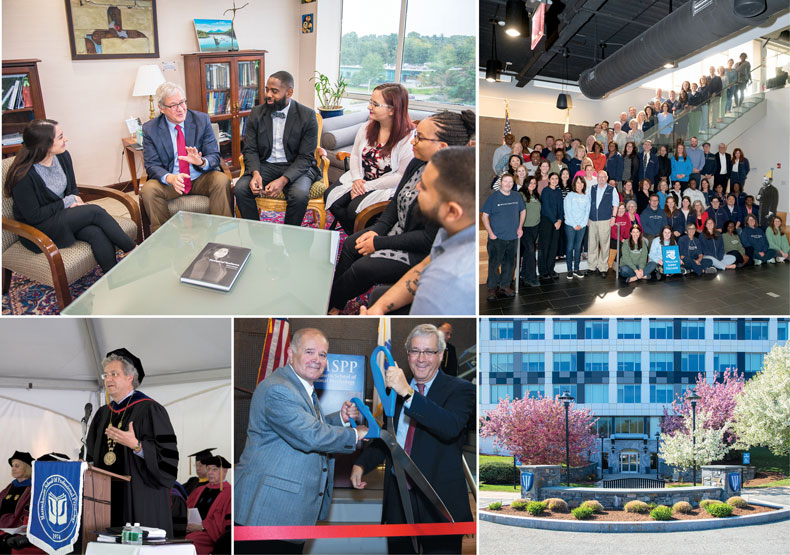
When President Nicholas A. Covino, PsyD, arrived in 2002, the Massachusetts School of Professional Psychology (MSPP) was a small but mighty graduate school with 130 students in a single doctoral program. Today, more than 1,100 students are enrolled across sixteen degree and certificate programs—evidence of a profound and sustained transformation over two and a half decades. Last spring, in a letter to the community, Covino called watching MSPP grow into William James College and become a recognized leader in applied psychology education one of the greatest privileges of his professional life.
“It makes me most proud to see what we have accomplished together,” he said, nodding to the students, faculty, staff, alumni, trustees, and community partners who helped build a college deeply committed to culturally responsive care, inclusion, and expanding access to behavioral health services.
As he prepares to step down after 25 years at the helm of William James College, we invited Covino to reflect on the people, culture, and sense of mission that have shaped the College during his tenure—from creating a “faculty of the whole” to welcoming perspectives that have not only transformed the College but also the field it is helping to build.
When you reflect on your 25 years at William James College, where does your mind go first?
I’ve been greatly impressed by the people who have come here to help us with the extraordinary work we’re doing. My colleagues are deeply loyal, mission-centered, and committed to our students and to making a difference in a field that needs to be highlighted, uplifted, and advanced. William James College has become a vehicle for their passion and, by doing this work collectively, we’ve gotten everyone’s best stuff.
Every institution has moments that shape its future. Looking back, can you identify a turning point that changed the course of William James College?
There have been more than several. Early on, given I was a psychologist and psychoanalyst not a business person, I had the good fortune of connecting with presidents of independent psychology schools across the country who became an incredible source of wisdom and support when navigating critical financial decisions. Our commitment to becoming more inclusive, by inviting individuals into the field whose points of view, lived experience, and knowledge had not been reflected previously in psychology, and this transformed the institution. Moving from a factory building into our current facility gave us a home to work collectively. The COVID-19 pandemic was another turning point. As a relational institution teaching people to do relational work, we could have easily gone out of business with people remaining six-feet apart; instead, our faculty, staff, and students adapted, and we emerged stronger and with better grounding in distance education.
Can you point to an initiative or program that felt like a leap of faith but became central to the College’s identity?
The first leap of faith was believing we could become a college, then endeavoring to become a more diverse and inclusive one by attracting and supporting students from communities that psychology had not successfully recruited previously. We intentionally took that transformation one important area at a time, turning to folks from the community at large for help building the curriculum, providing supervision, identifying community needs, and defining what good training should look like.
No one builds an institution alone. How has collaboration shaped the success of William James College?
Twenty five years ago, I vacuumed the rugs and set up chairs. Since that time, I’ve been very, very fortunate to have many partners—who helped build the systems, academic policies, and practices that didn’t exist in 2002—and together we’ve created something I’m extremely proud to have been part of. Through their extraordinary work, my faculty and staff colleagues, along with a number of passionate students, have created a culture of belonging and a mission that is becoming increasingly impactful. It’s a myth to think there is a single leader who can accomplish these things alone. One person can mess things up, but they can’t make it all happen!
Mental health has moved from the margins to the center of public conversation. How did that shift shape your priorities as a leader?
At the turn of this century, Dr. David Satcher commissioned the first study by a sitting US Surgeon General on Mental Health with a supplement on Race, Culture, and Ethnicity. He presented the lack of access to mental health care for all people and the critical importance of building a more diverse workforce in behavioral care. In December 2021, Surgeon General Vivek Murthy issued an advisory entitled Protecting Youth Mental Health. In it he said, “The challenges today’s generation of young people face are unprecedented and uniquely hard to navigate,” calling the effects on mental health “devastating” and declaring a Mental Health Emergency for America’s youth. These seismic shifts positioned William James College to increase our efforts to develop its competence in multicultural education and to deliver mental health services more broadly into the community. The College began in earnest to educate child and family practitioners, people from historically underserved communities, and K-12 and university educators, first responders and organizational leaders who could deliver primary prevention interventions as well as clinical care. The Center for Behavioral Health, Equity, and Leadership in Schools (BHELS) and Center for Crisis Response and Behavioral Health have been instrumental to this work.
In addition, these reports and the College’s greater investment in the community underscored the importance of including race, ethnicity, religious affiliation, military service, and other lived experience in psychology education.
The milestones are easy to see. What accomplishment beneath the surface are you most proud of?
I am really proud of the culture our community has built, one deeply invested in students’ growth, development, and well-being. One that pays attention to students’ lived experience, affiliation, and needs. A new faculty member shared that, after spending the first half of her career in higher education at other institutions, she never attended a faculty meeting like her first at WJC where so much of the conversation focused on what students need and how faculty could support them. I am equally proud when I hear students describe feeling truly seen and valued here. A young Asian woman at a New Year celebration said that ours was the first college she had attended where the person at the front of the classroom looked like her. That semester, she took classes with two Asian faculty members. To me, these moments speak to something bigger than any individual accomplishment: the creation of a community where people care deeply about one another, where students know they belong, and where access to care is being extended.
Helping prepare psychologists and behavioral health leaders has been central to your career. What’s something today’s students understand about the profession that students 25 years ago simply couldn’t have anticipated?
When I was in graduate school, there was regular competition for theoretical primacy which I found divisive and unhelpful. I think today’s students understand that psychology isn’t about choosing one tradition over another; there’s value in all of them. And while protocols and treatment techniques matter, relationships and compassion matter more. I’m proud that our graduates are not simply achievement-oriented—they’re other-oriented, generous of heart and spirit, and committed to taking care of others.
What would your closest colleagues say was the leadership principle that defined your presidency?
When I first arrived and the ship was sinking, the College needed a turnaround leader who shared information about required change but then needed to make decisions. Once the institution was more stable, I knew I had to lead differently. Sustaining change meant building infrastructure, attracting experts, and creating partnerships. I don’t sit at the head of the table any more; I try to lead from within. Much of what I know today, I learned from others and on the job.
As you reflect on the learning environment you hope to leave behind at William James College, what do you hope will endure?
Our primary role is to serve as facilitators and mentors in support of students. We are building a much more diverse learning community than exists in most psychology institutions. In gathering a more broadly diverse group, we need to pay closer attention to people’s needs for safety, belonging, respect, and to manage the inevitability of traumatic and hateful events in the outside world intruding into our learning environment. Going forward, our responsibility is to hold those differences in the crucible of our learning community, along with our accomplishments and disappointments, while remaining committed to the growth, development, safety, and security of all. We haven’t mastered that, and I don’t know that mastery is even attainable. But the aspiration is here, and the energy is here. We’re in the process of becoming.
Twenty-five years is long enough for countless memories. What’s one story that captures the spirit of William James College for you?
I’ll never forget watching our faculty light up, and in some instances dance with excitement, when they see students succeeding—whether they’ve won a scholarship, completed a project, or experienced an immersion that was meaningful to them. That joy in our students’ achievements, and in seeing them grow, perfectly captures the spirit of William James College I will carry with me. I feel honored to be part of this wonderful institution.
- Tags:
- Around Campus