
What is Mental Performance Consulting? Q&A with Program Director, Dr. Laura A. Hayden
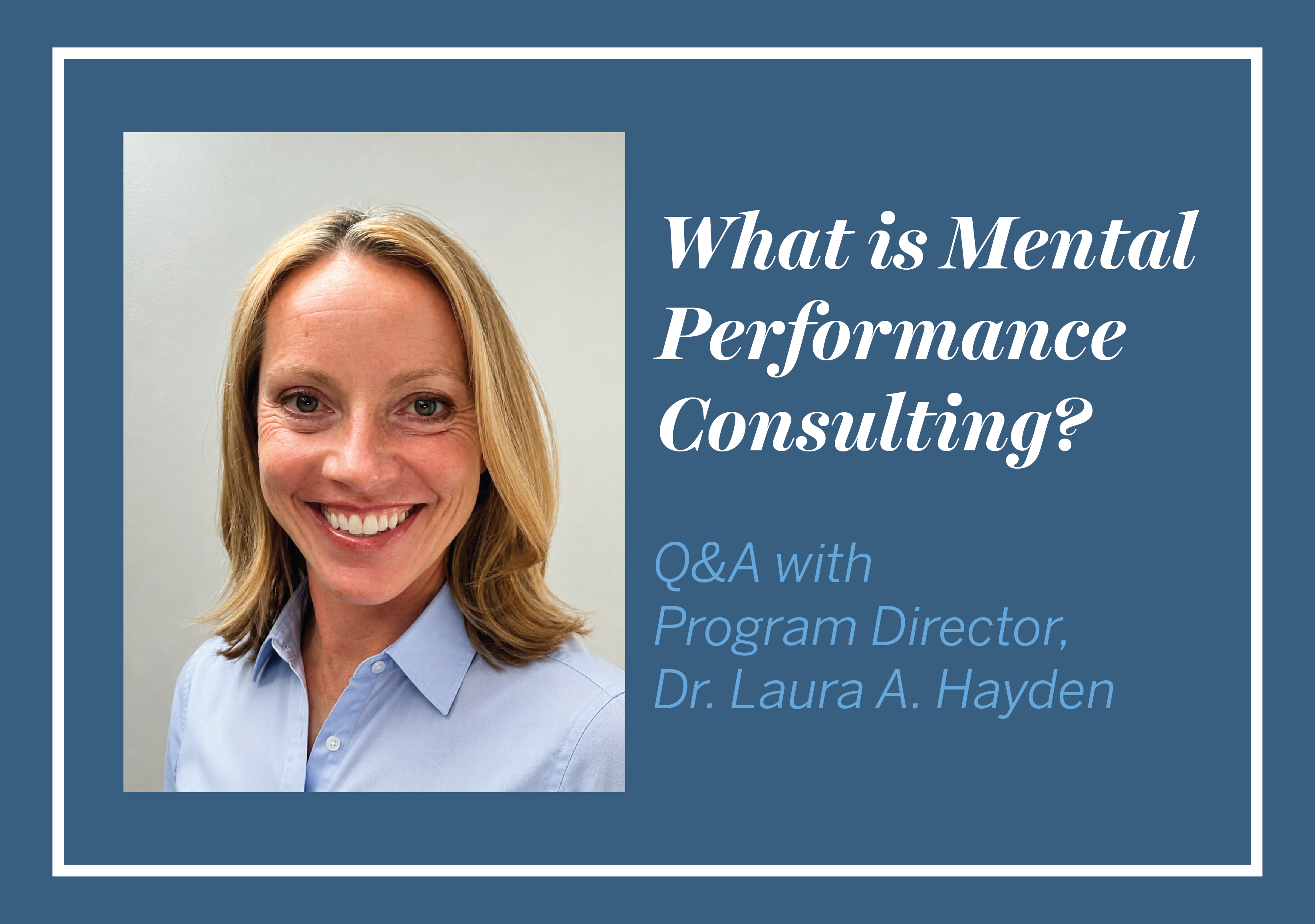
Are you interested in the field of mental performance consulting? Do you want to help those who perform in high pressure environments? At William James College, you can pursue a Graduate Certificate in Mental Performance Consulting or take the courses as a concentration in select programs. We sat down with program director, Laura A. Hayden, EdD, CMPC, to learn more about what mental performance consulting is, why it’s important, and what the program at William James College looks like.
1. What is mental performance consulting?
A. The way I describe mental performance consulting to people is that it's the practice of helping individuals and teams perform at their best through the development of various psychological skills and strategies. If you're a mental performance consultant, you’re working with those in any high-pressure environment where people are trying to optimize performance. You're helping them work on focus, confidence, motivation, resilience, performing under pressure, developing teams, and overall well-being.
2. Who does mental performance consulting benefit?
A. Mental performance consultants work with people in a high-performance setting, which means a setting where there's pressure to perform or where there's pressure to hit particular results. Historically, that has been athletes and teams (and most people still think of it as athletes and teams), but it's also business leaders and executives or people in the performing arts. It is for people in the military, first responders, healthcare professionals, coaches, educators. I've even worked with some students who need to go into high performance settings like high stakes exam settings or when they're thinking about college prep.
Anybody who is trying to perform well under pressure would work with a mental performance consultant and that doesn’t just mean people who are struggling. We have people who are already successful and are just trying to understand how to move from good to great who go to mental performance consultants.
3. What does a career in mental performance consulting look like?
A. Mental performance consultants are outsiders with expertise in performance enhancement who can help identify the needs of an individual or of a team and address them using evidence-based techniques. Most will have a private practice where they will work with a particular target audience. Oftentimes, that's in professional or collegiate sports, but many mental performance consultants also work in corporate leadership and executive development, or in healthcare and rehab settings, or military and tactical programs.
For example, a mental performance consultant may be working with an individual who is performing well in practice, but underperforming in a game. Using science-based psychological techniques, they would help that individual identify what’s contributing to that gap between practice and game performance and then what intervention will help optimize their performance when they're actually under pressure. The mental performance consultant might also work on team cohesion, developing leadership in the informal and the formal leaders of the team, or act as a liaison between the athletes and the coach. They can come in and do a battery of assessments and then start to understand the team and the culture to help facilitate change.
4. How do you become a certified mental performance consultant?
A. To be a certified mental performance consultant, there's a few requirements. Requirement number one is having a qualifying degree at the master's or doctoral level, which means a degree in counseling, psychology, or a related field. Requirement number two is hitting eight particular competency areas through coursework, including sports science, helping relationships, psychopathology, development across the lifespan, ethics, and culture and diversity. Then, the third requirement is 400 hours of fieldwork that’s supervised by a mentor. Once the Association for Applied Sports Psychology approves those components, you will be eligible to sit for the national exam and, if you pass, become a Certified Mental Performance Consultant.
5. What makes a good mental performance consultant?
A. The people who excel or succeed as mental performance consultants are people who are curious about others. They can and want to enter into somebody else's life, leave their ego at the door, and fully invest in that person’s success. It's a very entrepreneurial field so there’s a lot of being comfortable owning your domain, being confident and curious and understanding of other people's perspectives, knowing what you know and don't know, and knowing when to refer to others.
The other thing that I think that has kept me going all of these years has been having a team of other people in the field who I can talk to. It’s a group of people who I could go to when something gets hard for me as a consultant, or when something is kind of heavy, or I need to check myself, or I need to check my biases. So, building that team is also a helpful tool for future CMPCs.
6. How does mental performance consulting differ from sports psychology, executive coaching, therapy, or other fields?
A. People, I think, get a little bit confused between sports psychology, mental performance consulting, executive coaching, mental health therapist, right? Sports psychology is really the broader umbrella field that mental performance consulting grew out of. Historically, much of that work focused on athletes, coaches, and teams. Whereas, over the past 20 years or so, mental performance consulting has taken some of the components and strategies and interventions from sports psychology and applied them much more broadly to areas like business, the performing arts, the military, medicine, and really any environment in which people are expected to perform under pressure.
Executive coaching tends to focus on things like leadership development, communication, decision-making, or navigating a particular role. Mental performance consulting may overlap with that, but we’re often looking more specifically at the mental, emotional, and behavioral factors that affect performance. So, what happens to your attention under pressure? How do you respond when your confidence drops? How do stress, motivation, self-talk, or emotion affect your ability to perform consistently? Both fields are really important, they’re just coming at performance from somewhat different angles.
And then, mental performance consulting differs from traditional therapy in that mental performance consultants are not licensed clinicians. Some have dual training and licensure, and we often collaborate with therapists and other clinicians, but mental performance consulting itself is not mental health treatment. We’re not diagnosing or treating psychological disorders. Our focus is on performance enhancement: helping people develop the mental skills and strategies they need to perform well, respond to pressure, and function more consistently in demanding environments.
7. What are some misconceptions about mental performance consulting?
A. There's a few big ones. The first misconception is this idea that mental performance consulting is just visualization or positive self-talk, that it's not science, it's not rigorous, or it’s not a “real job.” Mental performance consulting is grounded in evidence-based psych theory and evidence-based research. MPCs use structured interventions and measurable strategies to enhance performance.
Secondly, some people think it's therapy or that we’re just packaging therapy in a way that's attractive to high performers. There can be overlaps where we use counseling skills, but our focus is on performance enhancement and as soon as something deviates from that and becomes clinically relevant, we refer our clients to appropriate clinicians.
Finally, and I think this is the biggest one, is that mental performance consulting is just for athletes or that it's sports psychology. That's partly because that's how it began and partly because that's still most of the people who work with mental performance consultants, but research keeps highlighting that the interventions that are successful in one domain transfer over to other domains. It's just now becoming more normalized and being used in different settings like performing arts or the military or in business settings.
8. What is unique about the mental performance consulting program at William James College?
A. Because William James offers a concentration or a graduate certificate, we're filling a gap for people who have a qualifying degree in counseling, psychology, school psychology, or in organizational leadership who don't have the sport-specific competencies. People can come to William James and take these four performance-specific courses without having to take extra credits. It’s an efficient, streamlined way to complete the final step for coursework that needs to happen for certification. It’s a program that is online and asynchronous, so it also offers a flexibility that allows people who are professionals or raising kids or doing their regular life to be able to develop this skill set.
So, while we’re training people to work in sport-based settings (because that’s where most people do work), our curriculum also includes readings, assignments, and opportunities to demonstrate competence in various other settings. There’s a massive need in that area because those non-sport spaces are growing in their need for and their understanding of mental performance consulting.
And lastly, here at William James, our whole college is a psychology-oriented college and our students receive psychology-driven training. So, everybody who's attracted to this program is going to find themselves around other like-minded people who are really interested in understanding human behavior. They will find that all of the extra offerings that William James has are all connected to human behavior and human development, which is really unique.
- Tags:
- Admissions Blog
- Around Campus
Topics/Tags
- Admissions Blog
- Faculty/Staff
- Alumni
- Students
- Partner Spotlight
- Expert Insights
- Press Release
- 50th Anniversary
Follow William James College
Media Contact
- Katie O'Hare
- Senior Director of Marketing and Communications
- katie_ohare@williamjames.edu
- 617-564-9389