
Veterans Day: Bringing Personal Understanding to the Work
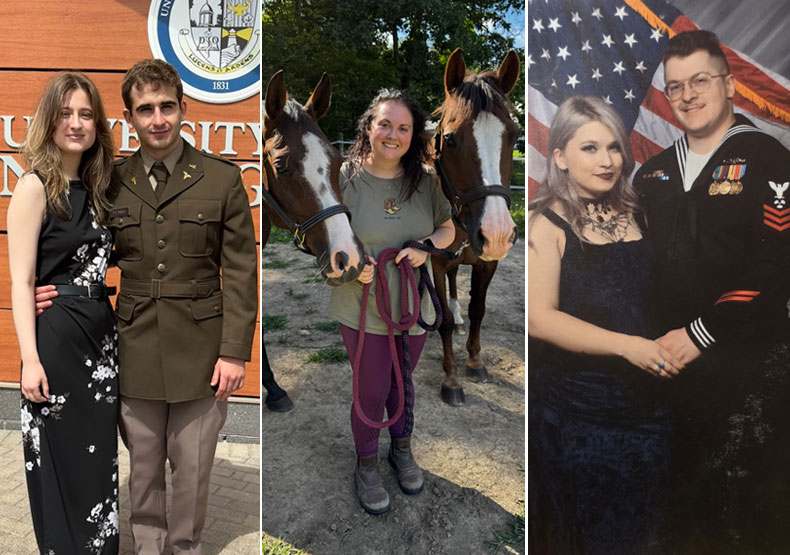
William James College Students (L to R): Peyton Shobe, Meghan Welsh, and Catie Frankel-King
Three William James College students are drawing on their connections to military life to inform their clinical training and help strengthen mental health support for veterans and their families.
Each year on November 11, we honor the service and sacrifices of those who have worn our nation's uniform. But honoring Veterans also means considering what happens after the homecoming, during the transitions, challenges, and everyday experiences that shape life beyond military service. It means ensuring Veterans and their families have access to mental health professionals who understand their experiences.
For Jenny D’Olympia, PsyD, LP, HSP, LMHC, a Veteran herself and associate professor in William James College's Counseling and Behavioral Health Department, that commitment takes two forms: creating pathways for people with military lived experience to enter the mental health profession and preparing community providers to better understand and support Veterans and their families.
Through the College's Military and Veterans Psychology (MVP) concentration, students develop the knowledge and clinical skills to serve military-connected communities. Three students from the Master's in Clinical Mental Health Counseling (CMHC) program are bringing an additional dimension to that training: personal connections to military life. Each has a spouse or partner with a connection to military service, experience that informs their perspectives and shapes the counselors they are becoming.
“Military families make sacrifices of their own,” says D’Olympia, pointing to missed holidays, birthdays, and countless moments together. “They are so often the foundation of the support systems our Veterans depend on.”
Read on to learn how personal connections to military service are shaping the next generation of mental health providers and their commitment to supporting Veterans and military families.
CATIE FRANKEL-KING, United Community and Family Services
When her husband deployed just six months into their relationship, Catie Frankel-King found herself navigating military culture with little understanding of what lay ahead. With limited communication and few connections to other military families, she quickly learned firsthand the challenges spouses face during deployment—a topic that ultimately informed her professional path. Through her husband's work aboard submarines, Frankel-King heard about the mental health challenges service members face which strengthened her desire to support this population as a clinical mental health counselor. Joining the MVP concentration while pursuing her master’s degree offered a distinctive opportunity: specialized training in a flexible online format that accommodates the frequent relocations that can come with military life.
“There is no guidebook on what to expect,” says Frankel-King, who has turned her lived experience into an opportunity to support others. At her internship with United Community and Family Services in Norwich, Conn., Frankel-King works with young veterans, military families, adolescents, and individuals navigating substance use challenges. The experience has reinforced an important lesson: effective care begins with setting aside assumptions, remaining open-minded, and meeting each client where they are. As the spouse of an active-duty Navy service member of 12 years, Frankel-King participates in COMPASS, a program that connects newer military spouses with guidance and resources for navigating relocation, child care, and mental health. Having experienced those uncertainties herself, she hopes to extend that support through her work as a licensed mental health counselor.
Frankel-King wants others to recognize that military families make significant sacrifices of their own, often unseen by those outside the military community. Deployments, training, and demanding duty schedules can mean long stretches of time away from one another.
“The benefits come with a price,” she says. “My husband and I have been together almost five years, but about half of that time has been spent apart—which is a big chunk of our lives together.”
PEYTON SHOBE, MGH Home Base
For Peyton Shobe, an interest in military mental health is also an opportunity to better understand her family's history. Her great-grandfather served in France during World War I, and her grandfather was a military police officer in the U.S. Army. Today, her partner's service in the Army Reserve has further deepened that connection. A desire to better understand her loved ones' collective experiences ultimately drew Shobe to the MVP concentration.
“Each service member has their own experiences, struggles, and story to tell,” says Shobe, a graduate intern at Mass General Hospital’s Home Base. She is putting her training into practice by working with service members and their family members, co-facilitating three outpatient groups and providing individual care using cognitive processing therapy (CPT), an evidence-based treatment for PTSD. These experiences are shaping Shobe’s approach to care while deepening her skills in trauma-informed treatment and substance use support.
“Not all wounds are visible,” says Shobe, who sees remarkable resilience and selflessness in those who serve. She believes effective care begins with recognizing that no two Veterans or service members are the same. With this in mind, Shobe strives to bring compassion, openness, and authenticity to each therapeutic relationship, tailoring care to individual goals and recognizing that even small steps toward healing represent meaningful progress.
Recognizing that military service affects the entire family, not just the individual in uniform, is essential to providing meaningful support. As Shobe puts it, “military families carry the burden of their own versions of service and sacrifice, and supporting the family is equally as important as supporting the service member.”
MEGHAN WELSH, Square Medical Group
Meghan Welsh has always had a deep respect for those who serve. Her grandfather was a World War II veteran, and her partner served in the Army, making this connection personal. Her own path to counseling has been far from traditional. After studying fashion merchandising and earning a master’s degree in criminal justice, she worked in the prison system, where she saw firsthand how trauma, mental health, and substance use shape people's lives. That experience led her into psychiatric healthcare and, ultimately, to a deeper interest in supporting Veterans and their families. Over time, Welsh has become increasingly interested in how trauma, identity, and the transition to civilian life affect this population, inspiring her to pursue the clinical skills to provide meaningful, respectful, and individualized care.
“The challenges Veterans and their families face are not always visible or easily understood,” says Welsh, whose personal relationships and clinical practice have taught her the importance of looking beyond assumptions and understanding each person's individual experience. Through her internship at Square Medical Group's River House, a residential substance use treatment program, Welsh provides individual counseling, facilitates groups, and works with individuals living with substance use disorders and mental health challenges. The experience has reinforced her understanding that progress looks different for everyone and strengthened her commitment to person-centered care.
Welsh hopes to bring compassion, curiosity, and an open mind to her work, incorporating experiential and nature-based approaches, including equine-assisted psychotherapy. She believes healing can happen beyond the traditional therapy office and wants Veterans and their families to feel heard, respected, and supported as they rediscover purpose, connection, and hope.
Above all, Welsh hopes others will recognize that military service is deeply personal and looks different for everyone.
“There is no single Veteran experience. Service may shape a person's identity, relationships, and family, but it does not define the whole person. Veterans are individuals who deserve to be seen and supported as such.”
- Tags:
- Veterans
- Around Campus