
Student-Parents Who Chose Education as an Act of Love
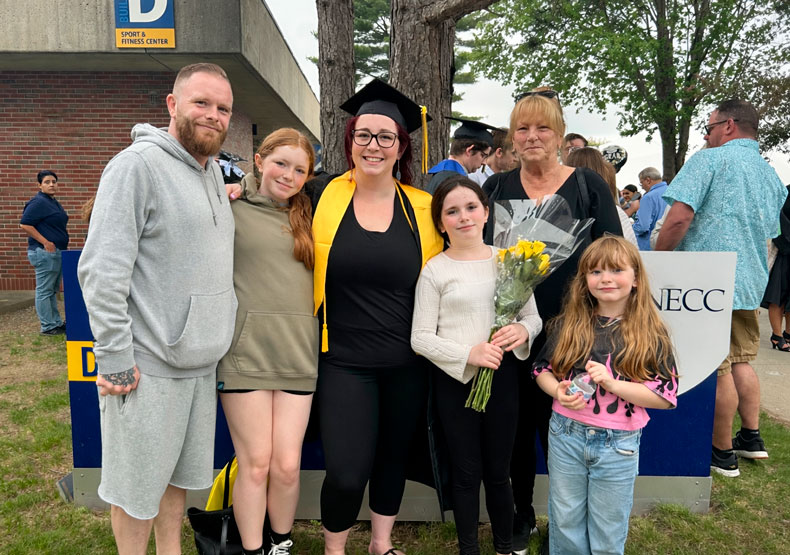
Bachelor's student, Harmony King, with her family
For students who are parents in the bachelor’s completion program at William James College, love often shows up in unexpected ways: late-night study sessions after bedtime stories, meetings with advisors between work shifts, and a quiet determination to build a better future—for themselves and their families. Balancing coursework with caregiving, student-parents pursuing a BS in Psychology and Human Services bring rich lived experience to the classroom, shaping how they learn and, ultimately, serve others.
“Our program is intentionally designed for real lives, complex responsibilities, and meaningful second acts,” says Kerri Augusto, PhD.
The Director of Undergraduate Studies makes clear that supporting student-parents is central to the program’s mission—offering the flexibility, structure, and support needed to make higher education possible without sacrificing family or wellbeing.
Read on to meet a trio of current student-parents who reveal how education, caregiving, and purpose intersect in the program—fueling meaningful careers in psychology and human services while strengthening their families and the communities they call home.
The Nonlinear Reality of Parenting and Education
Harmony King was learning about attachment, emotional regulation, and resilience long before she had the academic language to discuss these foundational social-emotional skills. As someone in recovery, becoming a parent forced her to look inward in ways nothing ever had. Returning to school enabled King to improve her own life and change the trajectory of her three daughters.
“Education has given me the tools to better understand what I was already living,” says King, a first-year student in the Bachelor of Science in Psychology and Human Services program who has been growing and changing alongside her three daughters since becoming a parent. After earning her GED and failing out of Northern Essex Community College (NECC) in her 20s, King returned to the classroom two decades later with the goal of becoming a drug and alcohol counselor. When an advisor suggested she pursue an associate’s degree in human services alongside the certificate program, King went for it.
“I fell in love with learning,” says King, underscoring that each psychology and human services course she took shifted her understanding of humanity and herself. Armed with a new sense of self worth, King enrolled at William James College. While the structured curriculum was challenging at first, King credits support from faculty and staff with making the journey meaningful and sustainable.
“The faculty are deeply engaged, and their feedback has helped me grow with each assignment. I am still overwhelmed at times, but I am confident this path is achievable,” says King, whose long-term career goals include supporting individuals and families impacted by addiction, trauma, and systemic barriers. She chose William James College because it honors lived experience and values the full human story.
“What I learn in the classroom shows up immediately in how I listen, respond to, and support others,” says King, who works at the Recovery Café in Lowell. Among folks who are experiencing homelessness, addiction, and trauma, King models a belief that recovery, education, and purpose can grow together.
“Being in community with my peers, providing person-centered assistance, has confirmed that doing this work is exactly where I belong,” says King, whose professional practice now influences her parenting. “I have learned to slow down, lead with curiosity, and center the person in front of me which means I respond differently to my children,” says King, adding that the four of them do homework together most evenings.
As to her advice for other parents contemplating a return to the classroom?
“Lifelong learning builds confidence, critical thinking, and self-worth—benefits that extend into families and communities,” says King, who reminds others that growth need not stop when life gets complicated.
“Returning to college as a parent is not a weakness, it’s an act of courage.”
Transforming Lived Experience into Professional Purpose
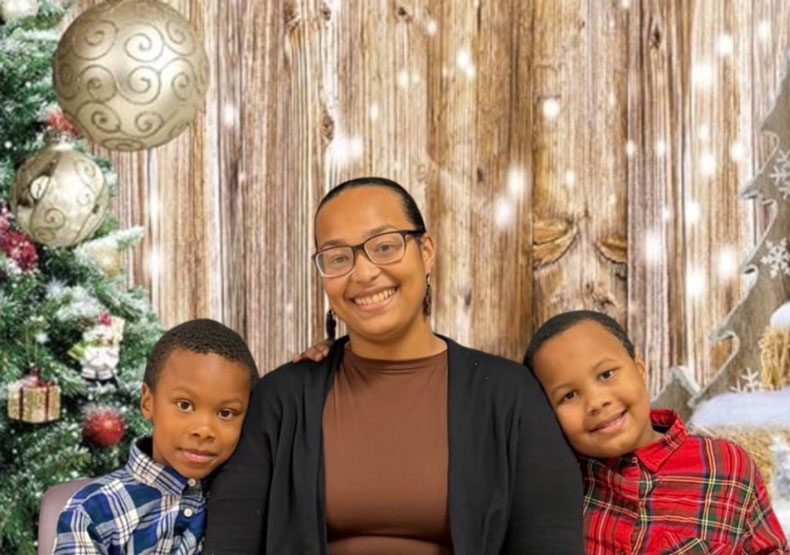
Imani Robinson was inspired to pursue a career in human services almost by accident. The single mother of two boys was enrolled in the Behavioral Health Technician Program, a partnership between the Center for Workforce Development and Boston Children’s Hospital, when her eldest son, who is autistic, was admitted for inpatient psychiatric services. What happened next caused Robinson’s personal experience to intersect with professional purpose—for the benefit of the entire family.
“Advocating for my son during a mental health challenge, by focusing on his strengths rather than his weaknesses, led me to pursue a career in behavioral health,” says Robinson, who suddenly found herself on both sides of the same process: providing direct care to behavioral health inpatients during her shifts and parenting one after hours.
While the battle to secure appropriate educational services for her son had been ongoing, being hospitalized marked the moment those challenges the family had been managing at home extended into unfamiliar territory.
That dual perspective, coupled with credits earned in the bachelor’s program as a non-matriculating student, gave Robinson insights that transformed how she approached her work.
"My experience [during the workforce training initiative] allowed me to tailor an on-the-ground approach to supporting individuals and families experiencing tense situations [like inpatient hospitalizations]," explains Robinson, who learned to create necessary boundaries and diminish biases she might have otherwise carried. Most importantly, it clarified her understanding of what it means to advocate for others.
"Advocacy is not speaking for another person, it's teaching that person to speak for themselves in order to access the tools they need in order to be successful," Robinson emphasizes. On the job, she has learned to ask herself: What can I offer the person in front of me in order to help them achieve the best version of themselves? Since matriculating in the BS in Psychology and Human Services program, Robinson’s toolkit has grown tremendously.
For Robinson, whose sons are now 8 and 9, earning a salary while continuing her education made pursuing a degree possible. But William James College offered something equally valuable: an environment that prioritizes advocacy. "All of what I am learning in the classroom allows me to better understand my son and pay it forward in support of others," says Robinson, of what keeps her hopeful. Her long-term career aspirations include becoming a social worker in a local school or hospital and using her lived experience to help others navigate challenges and find their voice.
In an environment rife with consistent communication from advisors and professors, Robinson has flourished. When challenges do arise, she has a supportive network invested in her success to call on.
Her advice to other parents contemplating a return to the classroom is simple:
“Choosing yourself is not selfish—it’s honestly one of the most selfless things you can do.”
Answering the Call to Human Services
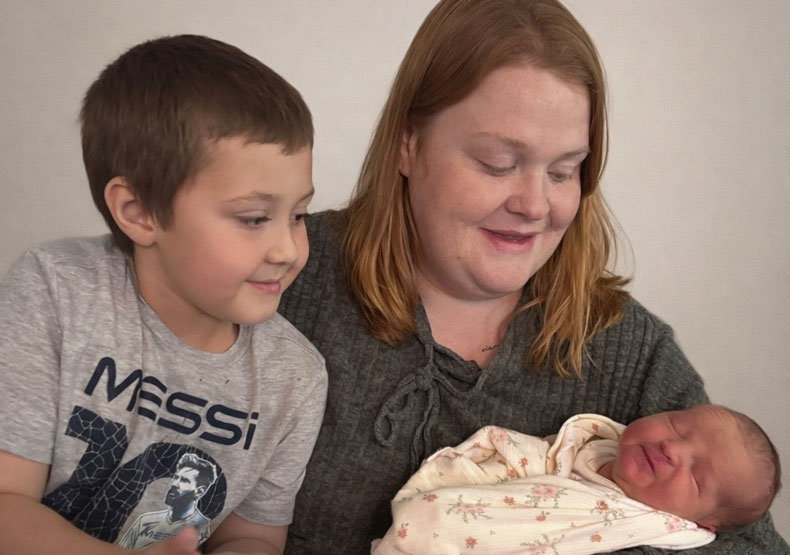
From the time she was in middle school, Chelsea Clain aspired to be in the helping field. Witnessing her mother’s ongoing struggle with mental health, amidst inpatient hospitalizations and limited support at home, sparked Clain’s interest in pursuing psychology. Becoming a mother herself proved a blessing in disguise—one that set Clain on a path of growth and self-discovery.
“I wanted to understand the why of it all, from my mother’s Bipolar I diagnosis to my own history of depression” says Clain, who grew up with limited conversations surrounding mental health. She knew her mom struggled in ways her friends’ moms did not, and her father arranged for her to attend therapy, but she was left with lots of questions.
Since learning about William James College (while a student at Massachusetts Bay Community College), Clain knew the answers were within reach. She also knew achieving her goal of becoming a mental health counselor would take time—a process she’s approaching step by step.
Now in her final semester of the BA in Psychology and Human Services program, Clain is awaiting acceptance to the College’s MA in Clinical Mental Health Counseling program.
“The decision to do something for myself, by focusing on school, has allowed me to make my children’s [early years] better than mine were,” says Clain, who welcomed her second child in early February.
When she is not parenting or studying, Clain works full time at Bridging Independent Living Together, Inc. in Woburn. In her role as general operations manager, she oversees a team working to empower and enrich the lives of people with disabilities through compassionate support.
“Human services is a call I feel obligated to answer,” says Clain who worked in customer service and elder care before joining the nonprofit four years ago. Lived experience parenting a child with ADHD has given her an empathetic lens through which to view her work, especially when supporting families facing challenges at home.
Clain is quick to acknowledge that her experience finding a new way forward in the wake of childhood challenges is not unique. Still, she encourages other parents to prioritize themselves and their passions.
“Figure out your why and keep fighting for it—especially if that involves going back to school.
- Tags:
- In the Community
Topics/Tags
- Admissions Blog
- Faculty/Staff
- Alumni
- Students
- Partner Spotlight
- Expert Insights
- Press Release
- 50th Anniversary
Follow William James College
Media Contact
- Katie O'Hare
- Senior Director of Marketing and Communications
- katie_ohare@williamjames.edu
- 617-564-9389