
The Kenya Immersion Program: Preparing Educators and Mental Health Professionals to Support Diverse Communities—at Home and Around the Globe
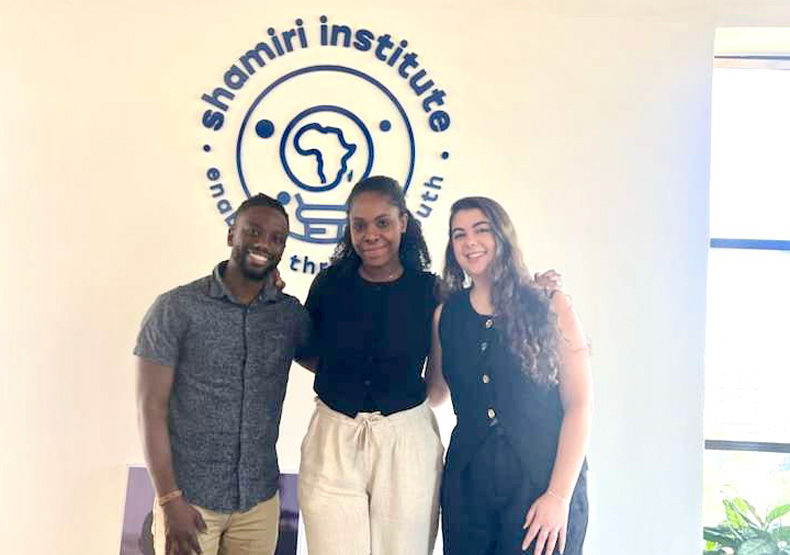
William James College students at the Shamiri Institute. (L to R) Tim Lwanga, Jennae Herbert, and Anya Shire-Plumb
A mutual passion for promoting global mental health and well-being connects Claire Fialkov, PhD, and David Haddad, EdD. Since 2015, the co-directors of the Kenya Immersion Program have been facilitating dynamic and experiential learning opportunities that address humanitarian needs in the East African nation. A program of the Center for Multicultural and Global Mental Health (CMGMH), the immersion provides hands-on global mental health service learning to support and enhance students’ academic coursework.
“Rather than remain in traditional student positions, [participants] engaged as part of an international team and stepped into collaborative leadership roles,” says Fialkov, nodding to meaningful growth in students’ engagement and perspective. Given the unpredictability of the immersion experience, the leaders sought students adept at tolerating ambiguity and adjusting thoughtfully when plans change, needs emerge, and circumstances require them to pivot.
“[Prioritizing teamwork allows us to] intentionally cultivate self-reflection and purposeful action rather than rigid adherence to pre-set plans,” says Haddad, nodding to ten days in December 2025 spent sharing meals, collaboratively setting and revising daily goals, and reflecting together on each day’s experiences.
“Unlike the classroom setting, where contact is limited, this sustained, relational context allowed students to practice flexibility, humility, and collaboration in real time,” says Haddad. The end result? A group of students Fialkov described as, “consistently curious and sincere, demonstrating a deep desire to learn while also genuinely wanting to help others.” Read on to learn more about the immersion in participants’ own words.
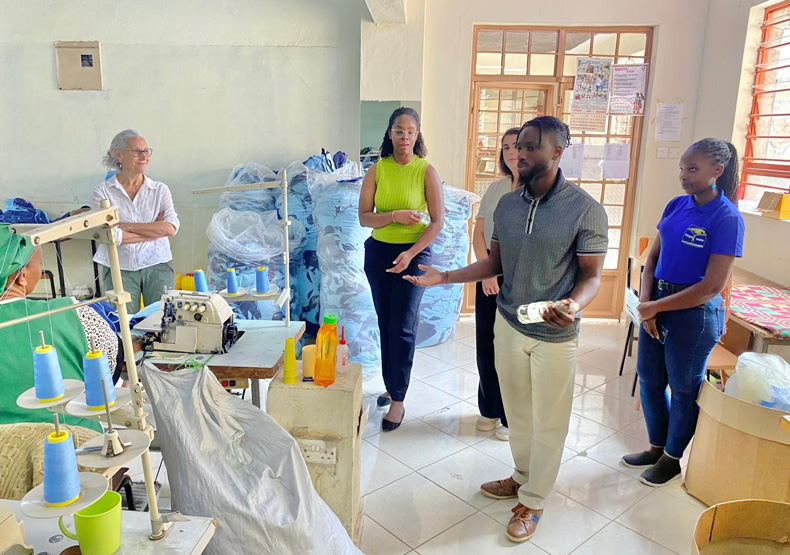
(L to R) Claire Fialkov, Jennae Herbert, Anya Shire-Plumb, Tim Lwanga, and Joan Alal Okoth from Kenya Works, at Makini Pad Factory
Cultivating a Global Lens
For Jennae Herbert, MA, participating in the Kenya immersion reflects both a deep personal calling and a clear professional vision. Originally from the British Virgin Islands, the doctoral student’s academic and clinical interests center on understanding how to support mental health within African and Caribbean communities. “Given that much of Caribbean culture has roots in Africa, I felt deeply drawn to the opportunity to connect with the land, people, and community in Kenya,” says Herbert, who welcomed the chance to move beyond Western frameworks and learn firsthand from those communities she aspires to support—about their lived experiences, values, and approaches to mental health care.
“Effective care begins with understanding how individuals and communities define well-being for themselves,” says Herbert, whose experience abroad challenged assumptions she didn’t realize she carried. Namely, expertise is not enough. Relationship-based care, collective responsibility, and culturally grounded approaches are essential to well-being.
After visiting Kenya Works to attend a graduation and rite-of-passage ceremony for girls who survived female genital mutilation and trafficking, Herbert was moved by stories of advocacy and self-determination. “Their joy, gratitude, and pride were infectious,” says Herbert, noting how the experience underscored the importance of being present and remaining open to learning from others’ lived experiences.
Advocating for and amplifying the voices of underserved populations remains a priority for Herbert. From her perspective, the process requires two steps: listening with intention to a community’s needs and working alongside them to support care in ways that are culturally aligned and sustainable.
“Observing how healing practices [in Kenya] are shaped by community, spirituality, and shared responsibility highlighted the limitations of applying a one-size-fits-all model across different cultural contexts,” says Herbert, emphasizing that mental health cannot be separated from culture, history, community values, and lived experience.
“Culturally responsive interventions are not optional, they’re essential.”
Reconnecting with Roots
For Timothy Lwanga, who hails from Uganda, the Kenya Immersion offered a meaningful opportunity to deepen his understanding of cultural differences while reconnecting with his African heritage. Experiencing a slice of life for people living in Africa, and learning first-hand their perspectives on mental health, helped the Clinical Mental Health Counseling masters student become more open minded about the field. “Western interventions do not work for Kenyans,” says Lwanga, nodding to systemic barriers—from cultural stigma to limited funding— that pose a challenge for aspiring mental health providers.
Interviewing a clinician at the Shamiri Institute, a leading African organization dedicated to advancing evidence-based mental health services, proved a meaningful learning experience for Lwanga. “Cultural differences and values necessitate culturally responsive interventions…[especially] among underserved populations,” says Lwanga, emphasizing the power of moving beyond the classroom in order to truly understand what culturally responsive care truly looks like.
Ultimately, the immersion reshaped Lwanga’s clinical identity. He now embraces a “not-knowing” stance, grounded in cultural humility and openness to uncertainty—an approach inspired directly by his time in Kenya.
“Engaging in service-learning and relationship-centered work—while witnessing the resilience, hope, and rich cultural traditions of the people being served—not only broadened my global perspective but also deepened my commitment to culturally competent practice and community-engaged work.”
Inspiring Cultural Curiosity
Providing culturally sensitive mental health care to a global population was top of mind for Anya Shire-Plumb when applying to graduate programs. Not surprisingly, William James College stood out. “The presence of the Global Mental Health Concentration and the Kenya Immersion influenced me to apply”, says Shire-Plumb, who hails from the United Kingdom—giving her a unique perspective on the immersion.
“Learning about the effects of British colonialism in Kenya, and witnessing how it continues to permeate African society today, was incredibly impactful,” says Shire-Plumb. Partnering with organizations doing important work, and contributing as professionals in collaboration with professors as colleagues, was equally rewarding.
The opportunity to dance and sing in celebration with young women at risk of female genital mutilation and child marriage in their communities stood out as powerful for the second-year Clinical Mental Health Counseling masters student. Equally impactful was the invitation to share her own Jewish faith via prayer, alongside Kenyan culture, at the start of a workshop for teachers and counselors at the Shamiri Institute. “For our different cultures to sit side-by-side in this way, in preparation of the important work ahead, felt very meaningful,” says Shire-Plumb who aspires to maintain cultural sensitivity in all contexts.
Before traveling to Kenya, she was curious about how the group of majority-white westerners could collaborate with local organizations without acting as top-down aid-bringers. To Shire-Plumb’s surprise, being on the ground in Nairobi allowed all involved to see how “bottom-up sustainable cross-cultural collaboration can occur in real time.”
An intention to approach the immersion as a curious learner and collaborator remains with Shire-Plumb who has gained a new perspective on her work.
“Staying curious, and leaving any preconceptions out of the [therapy] space, is crucial for understanding an individual’s relationship to their own cultural history.”
Looking Ahead
Growing recognition that mental health awareness is fundamental to overall well-being and academic success has led to an innovative initiative to advance global mental health and well-being. The Certificate in Positive Mental Health Literacy is a transformative one-year program designed to equip educators, social workers, counselors, and psychologists with the knowledge and practical tools to foster positive mental health in diverse learning environments.
Offered through a collaboration between William James College and the Shamiri Institute, the certificate combines rigorous social science research with contextual expertise in educational and mental healthcare systems—offering participants a unique opportunity to collaborate directly with Kenyan educators and mental health professionals and ensure that the spirit of the immersion continues to shape the next generation of providers.
Learn More about the Certificate in Positive Mental Health Literacy
The Certificate in Positive Mental Health Literacy is designed in response to a growing global recognition that mental health awareness is fundamental to overall well-being and academic success. According to the World Health Organization (WHO), approximately half of all mental health conditions—including anxiety and depression—emerge during childhood and adolescence. Today’s young people, particularly Generation Z, are navigating unprecedented social, environmental, and technological changes that have intensified experiences of anxiety, fear, and uncertainty. At the same time, this generation’s expressions of anger and rebellion reflect a deep desire for systemic change, justice, and a healthier, more sustainable future.
This certificate program equips educators, social workers, counselors, and psychologists with the knowledge and practical tools to foster positive mental health in diverse learning environments. Through a focus on prevention, early intervention, and resilience-building, participants will learn to identify mental health challenges, support their own and others' emotional well-being, and promote inclusive practices that empower youth to thrive. Grounded in a multidisciplinary framework, the program emphasizes collaboration among teachers and mental health professionals to create educational spaces where young people feel understood, supported, and inspired to transform their emotional energy into growth and engagement.
- Tags:
- In the Community
Topics/Tags
- Admissions Blog
- Faculty/Staff
- Alumni
- Students
- Partner Spotlight
- Expert Insights
- Press Release
- 50th Anniversary
Follow William James College
Media Contact
- Katie O'Hare
- Senior Director of Marketing and Communications
- katie_ohare@williamjames.edu
- 617-564-9389