
Spotlight on the Center for Crisis Response and Behavioral Health

(L to R) Dawn Martinsen, LCSW, Norton/Raynham Co-Response Clinician, and Officer Christopher McCarthy, Norton Police Department (Photography by Joshua Rizkalla)
An Intensive Training Model for Law Enforcement and Mental Health Professionals
Over his 15-year tenure as a patrolman with the Norton Police Department, Officer Christopher McCarthy has seen a sharp increase in calls for service involving individuals in crisis. For the past five years, he and a co-response clinician have been responding jointly to calls where behavioral health may be a factor—spanning children in crisis and elder abuse to substance use and suicide attempts. McCarthy and Dawn Martinsen, LCSW, recently attended a five-day Co-Response Intensive Training hosted by the Center for Crisis Response and Behavioral Health at William James College. The interdisciplinary approach reinforces growing data that shows diverting individuals committing non-violent offenses from the criminal justice system—and providing appropriate community-based behavioral health services—is the way forward.
Learning Objectives
When developing the curriculum, Sarah E. Abbott, PhD, Director of the Center for Crisis Response and Behavioral Health, employed a call-based approach rather than focus on global issues. “Skills are what matter in the moment,” says Abbott, underscoring her team’s primary objective: To ensure co-responders know how to manage what’s in front of them, whether that’s a domestic dispute or hoarding behavior. Topics addressed in two- and three-hour daily intensive sessions progress from Situational Awareness and Safety on 911 Calls and Rapid Clinical Assessment & Scene Management to Suicide and Risk Assessment for Co-Response Clinicians and Law Enforcement. Subsequent sessions are devoted to Responding to Families in Crisis as well as Death Notifications and Grief Support.
“Providing the skills needed to identify, manage, and de-escalate situations involving persons in crisis is our focus,” says Abbott, sharing what she knows from experience: Outside of this training, few, if any, folks in the field are being taught how to do so. Take, for instance, a rapid risk assessment.
“Getting a snapshot of why the individual in crisis is where they are, and what co-responders can do to keep them in their home with appropriate services, is far more important than what happened in childhood,” says Abbott, of the difference between assessing someone alongside law enforcement versus a clinical setting.
Real-Time Approaches
Learning by doing is the foundation of each short-term, capacity-building offering—all of which take an interdisciplinary approach.
“We look at different ways to provide immersive, interactive, and scenario-based training,” says Bonnie Cuccaro, MA, Associate Director of the CRBH, pointing to a prime example: the MILO (Multiple Interactive Learning Objectives) Range. This use-of-force and tactical judgment training simulator puts trainees in real-life scenarios where they must practice decision making under stress.
“We use this tool to focus on situational awareness, including appropriate positioning on calls, and how to skillfully step back if safety becomes a concern,” says Cuccaro. Another benefit of this technology is getting law enforcement and co-response clinicians communicating together on a call.
“The interactive MILO tool allows students to focus on a civilian’s cues, adjust personal behavior appropriately, and manage escalation if and when it arises,” explains Cuccaro pointing to a classic example: If a civilian has a crime to report, they may not want to talk about their mental health—and vice versa. Nuances in the MILO technology allow for scenarios to be paused and discussed along the way which facilitates debriefing.
“All of our trainings are taught by an interdisciplinary team to an interdisciplinary audience,” says Abbott who emphasizes that a police officer is always present to provide instruction and support. Further opportunities for hands-on learning include small-group discussion and intentional check-ins; Active Listening Skills and Crisis Negotiation; as well as Role Plays and In-Class Activities. Going forward, the Co-Response Intensive Training will be offered four times a year in various locations across the State including Municipal Police Training Facilities—in Lynnfield and Plymouth, respectively slated for February and Spring 2026—spaces made newly available to the CRBH.
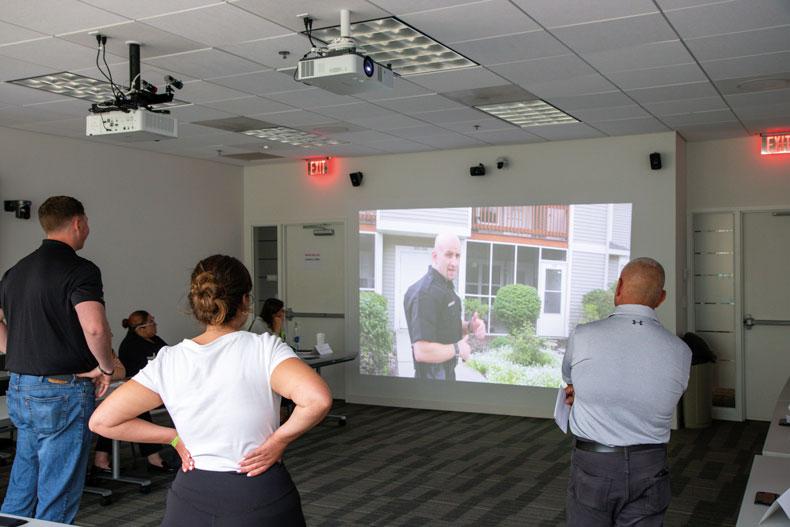
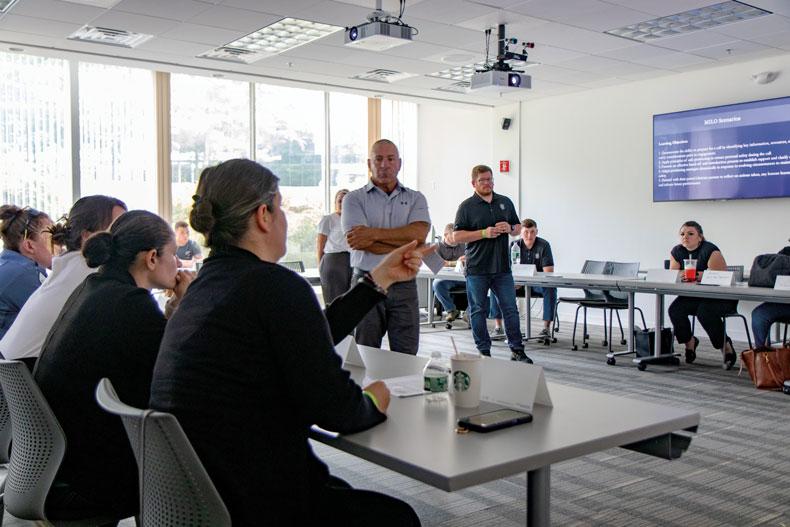
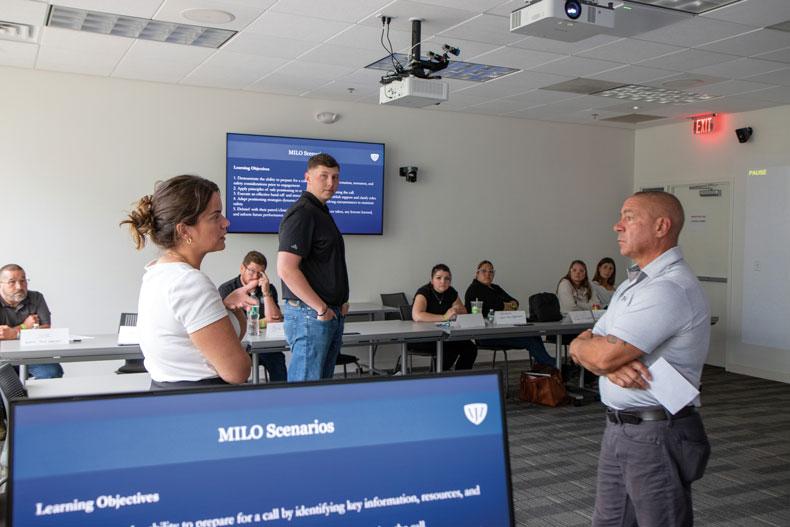
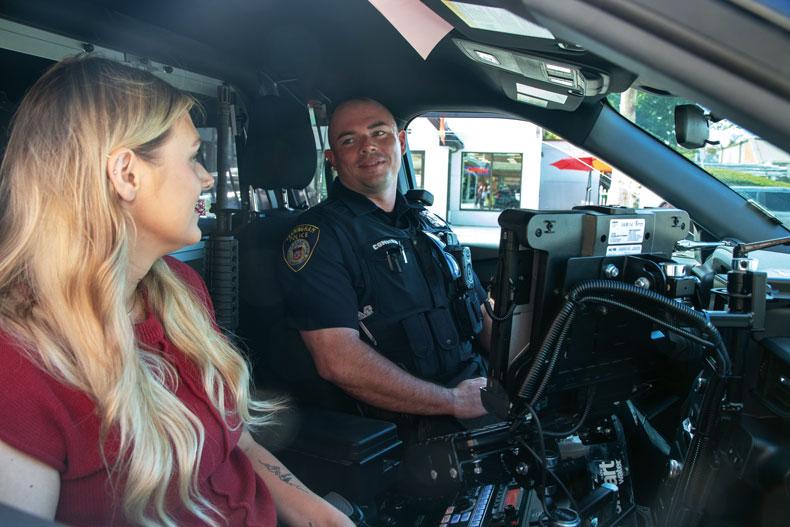
(Slides 1-3) Police Officers and Co-Response Clinicians attend an interactive co-response training at William James College using the MILO (Multiple Interactive Learning Objectives) Range. The MILO Range allows participants to practice situational awareness and safety using simulated real-life scenarios. (Slide 4) Madisyn Noonan, Framingham Co-Response Clinician, with Officer Brian Conner. (Photography by Joshua Rizkalla)
Benefits and Outcomes
Since 2022, The Center for Crisis Response and Behavioral Health at William James College has focused on providing training and education to law enforcement and mental health professionals on effective response methods for encounters with individuals who are experiencing a psychiatric, substance-related, or mental health crisis. Since that time, requests for grant funding and technical assistance through the Jail and Arrest Diversion Initiatives at the Massachusetts Department of Mental Health have continued to increase. In FY24 alone, 117 contracts were awarded in 100 cities and towns statewide; 42 of those (42.6%) were for implementing co-response programs.
“Participating in the Co-Response Intensive Training was not only educational and captivating but also relevant due to its being based upon real-world situations and scenarios that officers encounter daily,” says McCarthy, calling Abbott and Cuccaro’s on-the-ground experience—gleaned over a combined three decades as co-response clinicians with the Framingham Police Department—second to none. In addition to exceptional written feedback, data surrounding pre- and post-training skills and confidence suggests the training is effective.
“This 5-day intensive training model does not exist anywhere else in the Commonwealth,” says Abbott who, over the past year, has heard similar feedback from co-response clinicians and law enforcement alike:
- I wish I had this training prior to day one on the job
- This training should be mandatory for new hires
- Participating in this training as a department, before adding a co-response clinician, would have been so helpful
Thanks to first-hand experience creating effective partnerships between mental health and law enforcement, McCarthy is a fan of the model; in fact, he has high hopes the five-day training might soon be required for all new graduates of the Police Academy.
“The ability to take a step back, recognize the signs and symptoms of a mental health crisis, and utilize de-escalation techniques are invaluable on-the-job tools,” says McCarthy of the real takeaway: “Tools that could potentially avoid a hostile and deadly use-of-force situation when encountering individuals who are experiencing a psychiatric, substance-related, or mental health crisis.”
- Tags:
- In the Community
Topics/Tags
- Admissions Blog
- Faculty/Staff
- Alumni
- Students
- Partner Spotlight
- Expert Insights
- Press Release
- 50th Anniversary
Follow William James College
Media Contact
- Katie O'Hare
- Senior Director of Marketing and Communications
- katie_ohare@williamjames.edu
- 617-564-9389