
The Lucero Latino Mental Health Program at 20
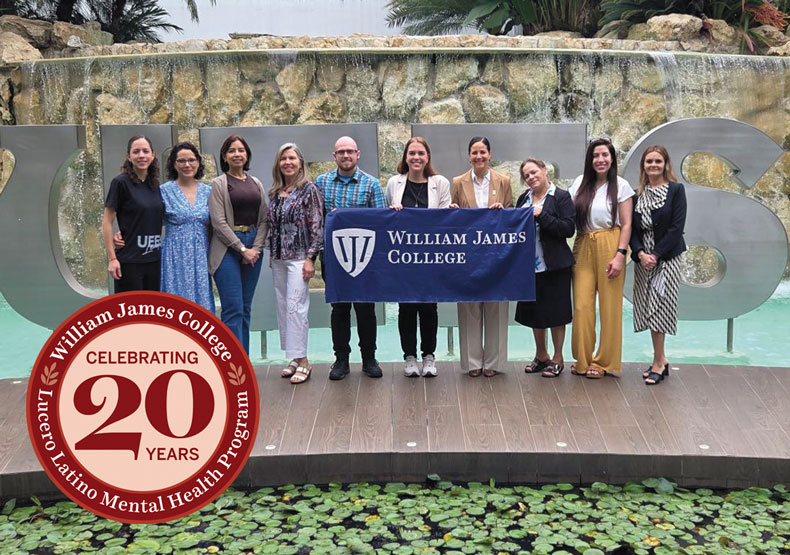
Mari Carmen Bennasar, PsyD, has built a career on inclusiveness. Prior to joining the William James College faculty in 2011, the bilingual clinical psychologist served as associate director of the Center for Multicultural Training in Psychology at Boston University Medical School for 15 years. Fully APA-accredited since 1986, the doctoral internship program trains providers to serve racially and ethnically diverse, low-income urban communities at elevated risk for mental health challenges. As someone of Dominican and Spanish heritage, Bennasar has a longstanding interest in Latino mental health.
In the early 2000s, she was invited to participate in community brainstorming sessions at the College. There, Bennasar joined President Nicholas A. Covino, PsyD, Amaro Laria, PhD, and other professionals in advocating for multicultural education in psychology and mental health counseling. Over the course of two years, they endeavored to create an academic program concentration in response to the underserved needs of the Hispanic community. When the Lucero Latino Mental Health Program (LMHP) was introduced in the fall of 2024, it sought to honor the memory of clinical psychology student Cynthia Lucero, who died while running the Boston Marathon, and expand access to mental health care for Spanish-speaking people. In the two decades since, the LMHP has created a model that is reshaping the American healthcare landscape. In an era where 40% of the U.S. population lives in mental health shortage areas, LMHP is deploying a force of specialists who break the cycle of underutilization. LMHP scholars represent the bridge to a future where 1 in 4 Americans will be Latino, ensuring that quality culturally empowering mental health care is a right, not a rarity.
“The LMHP is such a singular and influential program which has powerfully grown due to Mari’s stewardship,” says Natalie Cort, PhD, director of the Center for Multicultural and Global Mental Health.
On the occasion of its 20 year anniversary, President Nicholas A. Covino, PsyD, called the Lucero Latino Mental Health Program, “foundational in teaching William James College how to deliver meaningful multicultural education.”
We recently sat down with Bennasar who shared reflections on her time leading the program. Our conversation has been edited for length and clarity.
What moments from your time leading LMHP stand out to you most, and what do they reveal
about its impact?
I am proud of the community we have built, one that supports students academically and personally while at William James College and whose impact continues after graduation. I am equally proud of our graduates and their success—spanning a leader in the Hispanic Neuropsychology Society, a community advocate honored with a formal proclamation from the Mayor of Lawrence; and a forensic specialist at the Federal Bureau of Prisons in California. These individuals are proof that culturally attuned professionals are making an impact on many different levels: in the neuropsych testing world, on local families, and among black and brown people who are disproportionately incarcerated. And of course, I am proud that we became a model for the other concentrations that have followed, allowing William James College to expand training for additional marginalized groups utilizing the LMHP as a prototype.
By the numbers, 158 mental health providers have now been prepared through LMHP to meet the unique needs of underserved Latinx/Hispanic communities. In your experience, what happens when clinicians are trained to understand the cultural, linguistic and community contexts of the people they serve?
It profoundly transforms the healthcare mindset and the experience of our clients. Changing the dynamics of these interactions increases the chances that an individual is going to be more engaged and can make a commitment to being secure in treatment—which is often half the battle. Clinically speaking, cultural competency significantly decreases the chances of misdiagnosing, mislabeling, and misunderstanding what the real issues are. Understanding familismo means recognizing that family comes first, so a 40-year-old living at home to help their mother is not cause for pathologizing. Understanding personalismo means recognizing warmth and affection as expressions of connection, not a lack of boundaries.
Before putting a label on any situation, we must ask ourselves: Is there any cultural, sociopolitical, or community context that can account for this behavior? For the culturally attuned professional, this is a key question—one that seeks to build connection
Over the past 20 years, how has the mental health landscape for Latinx/Hispanic communities changed, and how has LMHP had to evolve in response?
The social and political situation has changed dramatically. Acculturative stress is already high for many immigrants, who leave their homes because of economic limitations, violence, war, and the hope of a better life for their children. They arrive looking for relief, peace, love, and warmth. When they encounter closed doors or the threat of family separation, that stress increases.
Current circumstances and climate are negatively impacting general access to care as individuals who were becoming more open to counseling/psychotherapy are now afraid to seek help, especially those who are undocumented. So the need has increased. Now more than ever, it is important to attract professionals—whether they work in clinical settings, schools, or local nonprofits—who understand how these communities are experiencing life in the United States. We continue to respond by having difficult conversations, addressing current issues in class, and building connections with community organizations that serve these populations. Understanding the circumstances people bring with them and the challenges they continue to face is more important than ever.
LMHP has paved the way in demonstrating the value of preparing clinicians to serve specific communities, as evidenced by a growing number of concentrations focused on historically marginalized populations. What do you think the College learned from LMHP that has shaped this broader approach to mental health education?
We learned that it works! The effort required to create specialty programs that combine academic classes with experiential clinical experiences increases the number of culturally competent trainees in the workforce, meets the needs of underserved communities, and decreases disparities in the system. Creating communities that support and train students who have not always thrived in other settings positions them to be successful while on campus and to serve their communities after graduation. Our academic and mentorship programs have grown to include African and Caribbean, Asian, and Global mental health as well as the Black Mental Health Graduate Academy—proof that understanding the cultural needs of a specific community benefits everyone. The more programs like this there are, the better. It’s not competition; it’s collective thinking.
As you look ahead, what is the next chapter for this work? What still needs to change, and what do you hope the next generation of clinicians will carry forward from LMHP?
In many small ways, the future is here! We have strengthened the quality of our curriculum, increased the number of credits, and developed many field sites serving Latino and Hispanic populations. Local immersion experiences continue to complement our month-long immersion program in Ecuador, and training options now include a trio of enrollment levels to accommodate different students’ desired depth of study.
In terms of leadership, I have made the decision—together with my peers in the Center for Multicultural and Global Mental Health—that this will be my last year as director of the Latino Mental Health Program. While I will continue teaching, working in the community, and co-leading the immersion program, Marta Pagan-Ortiz, PhD, will officially take over leadership of the LMHP in fall 2027.
Finding someone to carry the legacy of this work forward feels so timely. I hope the program continues to uphold its essential values of equality and community while embracing new creativity and thinking. Every program benefits from a new generation of ideas. We need to keep learning and adapting to a changing world so we can best serve our students and communities.
- Tags:
- In the Community