
Faculty Spotlight: Shannon M. Arthur Joins ABA Faculty
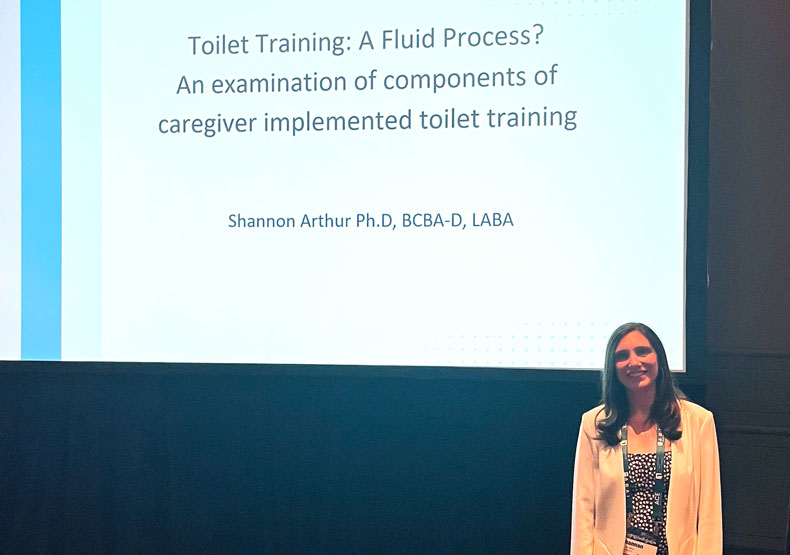
For Shannon M. Arthur, PhD, BCBA-D, LABA, a dislike of rodents proved the unlikely impetus for her current area of expertise. While studying traditional child psychology as an undergrad, Arthur encountered a course that required the use of operant conditioning (B.F. Skinner’s theory that consequences shape behavior) to teach a rat to traverse a maze. Given the option to learn the same principles in the child behavior lab, Arthur took it—paving the way for a career rooted in Applied Behavior Analysis. At its core, ABA targets “socially significant” behaviors—those that are meaningful to change for the individual—by reinforcing appropriate behaviors to reduce unwanted ones. A relatively young science that has found its success in treating autism, ABA can be used anywhere a change in behavior is sought. As to what fuels Arthur’s passion for the field?
“The meaningful change I continue to see when I work with at-risk populations and apply the science of ABA to real-world problems keeps me going,” says Arthur of her work in applied settings from school to the workplace and dozens in between. The Assistant Professor joined the Applied Behavior Analysis faculty in August.
Why William James College?
For Arthur, whose research and practice interests include Autism and Developmental Disabilities along with Toilet Training Interventions, an emphasis on practical application of the science behind ABA made William James College an excellent fit.
“While as professionals we need to know the history and basic principles of ABA, the most interesting part to me is the applied piece—and I like that our ABA program emphasizes practicality,” says Arthur, underscoring that students study the science of behavior in order to inform individualized therapy practices for a variety of populations. As a result, two big-picture questions rank among Arthur’s favorites for students to consider: How are you going to use ABA in your practice? Why is it relevant to you in your job?
Practice Meets Classroom
Prior to her work with aspiring BCBAs, Arthur’s experience spanned the Institute for Child Development at Binghamton University (a clinic for children with autism and learning disabilities) to a private school for children with severe disabilities including one-to-one behavioral issues and non-speaking autism. These days, she prepares students for the real-world by introducing them to a wide variety of assessments to help inform their decision making and develop appropriate behavioral interventions. “Before a problem behavior can be resolved, it must first be determined why it is occurring,” says Arthur, who teaches Behavioral Assessments, Behavioral Interventions, and Professional Practice and Research Seminar.
Over the past semester, two of her students were particularly successful at taking what they learned and applying it outside of the classroom. One implemented Functional Communication Training (FCT) — an ABA technique that replaces challenging behavior by teaching an alternative way to communicate needs—while working with a nonverbal child. With approval from their field site supervisor, this student modified how information was presented to the non-speaking child on their AAC device in order to make the desired outcome, a decrease in aggression and increase in appropriate communication, easier to achieve. Another explored using virtual reality to teach appropriate sexual behavior in context for individuals of all ages—a difficult task given ethical concerns and privacy laws—a topic underrepresented in research. Faced with an actual problem encountered in the field, this student was able to devise a novel, creative intervention for use in various scenarios that cannot be put into context (not unlike teaching stranger abduction prevention skills, the topic of Arthur’s master’s thesis).
Looking Ahead
Given the niche ABA has historically occupied, there is a high level of burnout among folks working in schools, clinics, and private practice in support of individuals with developmental disabilities—a trend Arthur seeks to change. “Our field extends far beyond providing treatment to individuals with autism,” says Arthur, underscoring what really excites her about the future of ABA.
“I aim to broaden students’ view of how ABA can be used in a professional setting to solve problems they care about,” says Arthur who counts Teaching Clinical Judgement Skills and Toilet Training Interventions among her research areas of expertise.
“You can work with the geriatric population, you can help companies increase productivity, you can coach an athlete how to improve their golf swing—all using ABA.”
- Tags:
- Around Campus
Topics/Tags
- Admissions Blog
- Faculty/Staff
- Alumni
- Students
- Partner Spotlight
- Expert Insights
- Press Release
- 50th Anniversary
Follow William James College
Media Contact
- Katie O'Hare
- Senior Director of Marketing and Communications
- katie_ohare@williamjames.edu
- 617-564-9389