
When Purpose Calls: A Career Change Rooted in Connection
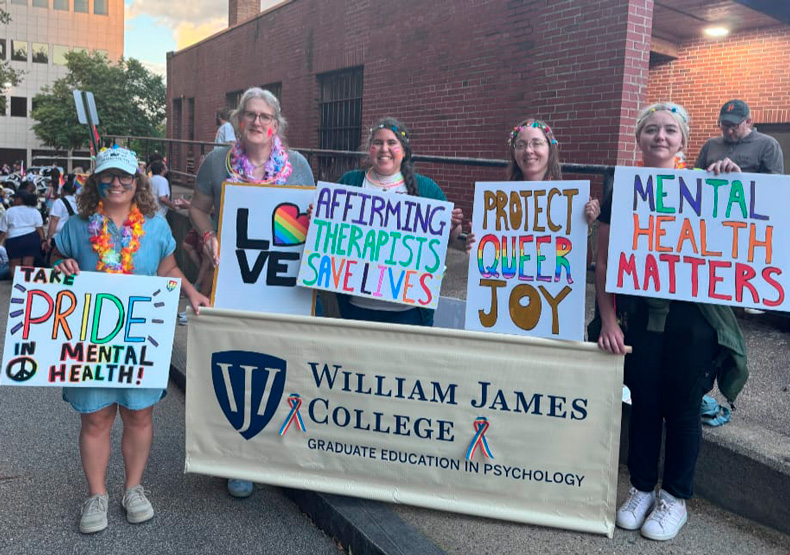
The William James College contingent at RI Pride 2026
Few folks understand the power of a well-timed pivot quite like Nicola Hassapis, MA. After building a successful career in communications and content creation, the 2026 graduate of the MA in Clinical Mental Health Counseling program charted a new course—one focused on helping others navigate their own stories and the challenges within. As to the catalyst? A recurring Thursday evening shift with The Trevor Project that entailed providing direct support to LGBTQIA+ youth in crisis.
“The three hours I spent as a digital crisis counselor quickly became the most meaningful part of my week,” recalls Hassapis, who began volunteering in June 2020; three years later, they enrolled at William James College. Along the way, Hassapis discovered a deeper understanding of the communities they hope to serve, an unexpected leadership opportunity, and a professional path aligned with their values.
Changing Course with Intention
Drawn to the intersection of mental health, social justice, and advocacy, Hassapis chose William James College for its commitment to serving underserved communities and addressing the systemic barriers that can limit these communities' opportunities and well-being.
“I really appreciated the tight-knit relationships that developed not only among students but also with professors,” says Hassapis. Earlier this month, they graduated with an emphasis in Forensic and Correctional Counseling and a concentration in LGBTQIA+ Studies, joining the small-but-mighty community of folks at the school who are passionate about working with these two therapeutic populations. While the Forensic and Correctional Counseling area of emphasis prepares clinicians to provide mental health and substance use treatments to individuals navigating the legal, judicial, and correctional systems, the LGBTQIA+ Studies concentration provides mental health professionals with the language, cultural sensitivity, and clinical competence required to deliver high-quality care to LGBTQIA+ populations. Both aspire to eliminate societal disparities that exist in relation to access and quality of mental health care among marginalized populations.
“Certain groups are overrepresented throughout the criminal justice system—spanning conviction rates and length of incarceration to opportunities upon release—and people of color and LGBTQIA+ folks are among them,” says Hassapis, whose passion for addressing systemic disenfranchisement runs deep. Widespread misconceptions about individuals from marginalized groups have been shown to impact opportunity across the board, from employment and wages to physical and mental health. Knowing this drew Hassapis to counseling and connected them with the populations they aspire to serve; it also allowed them to create meaningful connections on campus, an instrumental part of Hassapis’ journey at William James College.
When they stepped forward to co-lead the Rainbow Alliance, Hassapis was pleased to learn that the dozen years spent organizing projects, communicating with precision, listening carefully, and navigating complex relationships in the corporate world translated naturally to community building at William James College.
“It was validating to discover that the skills and expertise associated with my previous career were instrumental in managing and leading the Rainbow Alliance,” says Hassapis. During their tenure as co-leader of the group alongside fellow CMHC program graduates Rylan Guthrie and Sophie Lyons, the Rainbow Alliance sent monthly emails to members, promoted LGBTQIA+ events in the Boston area (including Boston Pride for the People, in which they marched last year), and hosted virtual and in-person events of their own design. In many ways, the role helped Hassapis realize their first career had been preparation for the work ahead.
Leading with Empathy
Ultimately, William James College has helped Hassapis turn a calling into a career. A practicum at Women’s Lunch Place in Boston positioned Hassapis to support day shelter guests experiencing homelessness, mental illness, substance use, trauma, and intimate partner violence using a clinical lens. The following year's internship placement at Boston GLASS, a Justice Resource Institute (JRI) program serving LGBTQIA+ youth of color, allowed Hassapis to confirm what drives them forward: working with communities who hold marginalized identities.
“These folks are not having an easy time of it right now and deserve the support they have been disproportionately deprived of for too long,” says Hassapis, reflecting on their own trajectory in the field. Since completing the Trevor Project’s 12-week training rooted in the basic therapeutic principles of crisis work, Hassapis has combined classroom knowledge with hands-on experience to become a culturally responsive professional.
“William James College has set me up to recognize my specific strengths as a therapist and understand the therapeutic modalities that resonate with me and will be most helpful to the different people I work with,” says Hassapis, pointing to the example of feminist therapy—an approach that examines how systems can affect an individual's mental health.
“If you are a Black woman dealing with depression, that might be a reflection of the fact that you are dealing with misogyny and racism in America, and that did not arise in isolation,” says Hassapis, emphasizing that mental health conditions often stem from societal pressures and inequities as opposed to personal defects, an understanding they bring to their clients on a daily basis.
Building Belonging, One Conversation at a Time
Hassapis’ career pivot comes with resounding ripple effects for many. At the conclusion of their clinical internship with JRI’s GLBTQ+ Adolescent Social Services, Hassapis was offered a full-time role as an outpatient clinician for the program. In addition to providing culturally responsive mental health support and clinical case management through Boston GLASS, they will support LGBTQIA+ youth of color in navigating issues related to identity and interpersonal relationships.
Given their start providing one-time digital crisis support through The Trevor Project with little opportunity for follow up, building rapport with GLASS clients over repeat sessions ranks among Hassapis’ top accomplishments. And among the population they currently serve—individuals with multiple marginalized identities—the stakes are high. According to The Trevor Project, 60% of multiracial LGBTQIA+ youth reported symptoms of depression in the past two weeks (of the 2022 National Survey on LGBTQ Youth Mental Health) —a statistic Hassapis is keenly aware of.
With diploma in hand and an eye on the future, Hassapis is equipped with the skills, experience, and perspective gathered along the way to continue making an impact in their chosen field.
“At William James College, I have built an awesome network of professionals equipped to support a diverse range of individuals with lived experience of being misunderstood or overlooked,” they said.
For Hassapis, the journey from communications to counseling was never simply about changing careers. It was about answering a call to connect more deeply with others—and finding purpose in helping people feel seen, heard, and understood.
- Tags:
- Research & Advocacy
Topics/Tags
- Admissions Blog
- Faculty/Staff
- Alumni
- Students
- Partner Spotlight
- Expert Insights
- Press Release
- 50th Anniversary
Follow William James College
Media Contact
- Katie O'Hare
- Senior Director of Marketing and Communications
- katie_ohare@williamjames.edu
- 617-564-9389